
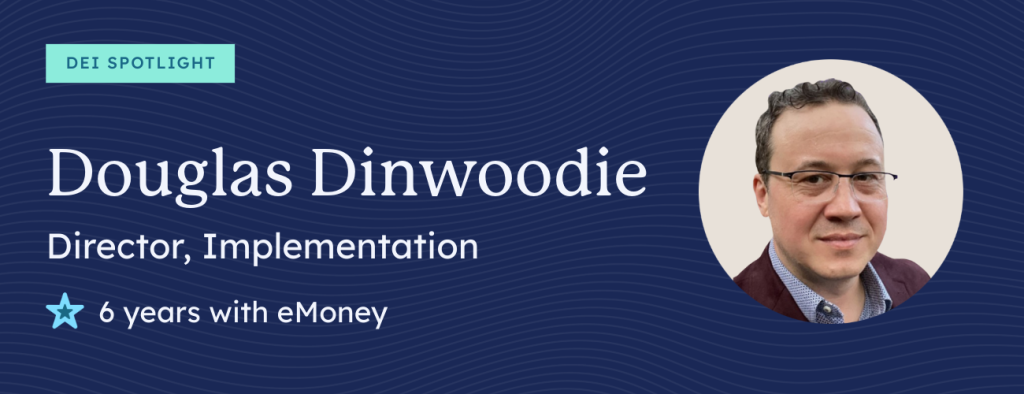
What does diversity, equality, and inclusion mean to you?
To me, diversity is about surrounding myself with people whose backgrounds, experiences, and ways of seeing the world are different from my own—so I’m constantly learning and never stuck in an echo chamber. Equality means making sure our rules and resources don’t accidentally favor one group over another—so everyone has a fair shot. And inclusion is the every day habit of inviting voices in, listening when they speak up, and then actually acting on what we hear so nobody ever feels like they don’t belong.
How would you like to see eMoney’s DEI efforts grow or evolve?
What impact do you hope DEI will have on our culture long term?
I picture a place where people don’t just tolerate differences but really lean into them—where speaking up with an “oddball” idea feels as natural as a status update. I hope eMoney is known as the kind of company where folks come for the tech/product but stay (and refer friends) because they feel seen, heard, and valued every day.
Can you share a story that shaped your perspective on DEI?
I experience what I call “overt privilege, hidden marginality”: my name lets me occupy most spaces without anyone guessing I’m Jewish, yet in (often heated) conversations about Judaism or Israel I overhear both fierce intra-Jewish debates and offhand remarks to me from people who wouldn’t speak that way if they knew that just off-camera is a shelf with my Torah, Tallit, and Shabbat candles. This tension exhausts me on behalf of those who are othered every day and reminds me how it feels to be casually sidelined. It drives me to pause, ask questions, and make room for voices that so often go unheard. It guides how I attempt to build fairness and belonging in every team and project I touch.
How do you think DEI contributes to business success?
I imagine an eMoney where pitching a “wild” idea feels as natural as grabbing coffee—where people stick around because they know their whole selves matter here, not just their job title. Over time, that translates into higher energy, stronger collaboration, and a reputation as a place where everyone—regardless of background—can build a career.
Do you have any examples that you can share where diversity helped spark innovation or solve a business challenge?
My team – Client Implementation – spends a lot of our time and effort working across borders. We work with key clients, but also partner internally with others in Service, Product, Dev, Sales, operations and more. When we encounter a rough spot, for example in transition between Sales and my team, I like to get people together who don’t all think alike to play with the problem from multiple angles. The time we spend with the issue allows us to discover the essence of the interaction, and leads us to creative solutions that seem obvious in retrospect, because they respect and meet diverse needs — rather than my team “winning” or “losing.”
How do inclusive teams impact business performance in your experience?
When people feel they truly belong, they speak up early about problems (so we avoid costly mistakes), they stick around longer (saving us from constant hiring churn), and they bring fresh ideas (because they’re not afraid to be themselves). All of that adds up to smoother projects, happier clients, and a stronger bottom line.
Can you recommend any books, podcasts, articles, documentaries, or other resources that helped you expand your outlook and understanding about DEI?
Oh yes. I am still learning and have a long way to go. 1) Book – Dare to Lead by Brené Brown (on vulnerability and trust in teams) 2) Book – Thinking Fast & Slow – Daniel Kahneman’s nobel prize-winning work on cognition and unconscious bias — but also how essential shortcuts are to your brain when governed mindfully 3) Anything by my professor Ahmad Brown, a fantastic thinker and communicator on this topic. Here’s a recent publicly-accessible article: “Organizational Justice” by Brown & Coukos in SSIR (helped me see DEI as a system of fair processes, not just one-off training)


Thank you Doug for sharing your inputs. Very glad to have you on the DEILC , with the passion you have for what DEI means to you!
Awesome. Thanks for these insights, and for your thought leadership here, Doug!