
Mental Health Awareness Month has been observed in the U.S. since 1949 to help increase awareness of the importance of mental health and wellness in Americans’ lives, and to celebrate recovery from mental illness.
Tom DeFelice, a Senior QA Analyst in Technology, shared his personal mental health journey with us – which can be found below. NOTE: A glossary of terms used in Tom’s story can be found at the bottom of this article.
As a reminder, eMoney values work/life balance, and we know everyone needs some additional help and support in both work and life every now and then. To view the mental health and wellness resources available to you, please click here.
My story with mental health started ~15 years ago when I first experienced clinical depression. I had started my first ‘adult’ job about a year prior, and I suddenly became unable to function….at all, really. One of the biggest misconceptions regarding depression is that the person is just sad all the time. The truth is that it’s not sadness—it’s nothing. A void of apathy takes residence where happiness, sadness, interests, and ambitions used to live. Through medication, therapy, and the support of those around me, I pulled myself out of that hole, though it would come and go throughout the following years.
I didn’t know when I needed support—not always, anyway. Through the years I would have my diagnoses changed from depression to anxiety, to bipolar depending on the doctor. It wasn’t until roughly the end of my first year with eMoney that I learned of (and realized I needed support for) ADHD. This is around the same time I began having difficulties on the team I was hired with, and also the time that I saw the TEDx Talk “Failing at Normal: An ADHD Success Story” by Jessica McCabe. The story she told of being an excellent student, only to enter the ‘professional’ world to constantly find she wasn’t performing to her potential, and that she was frequently burning out was one that hit home hard. It was then that I started researching ADHD (and ASD, for unrelated reasons), and sought out diagnoses which led to me getting the help I’d needed the whole time.
The support of therapists and doctors hasn’t just improved my ability to function better, it’s made it possible in the first place. A concept for energy thrown around in the mental health space a lot is Spoon Theory. This term was originally coined in 2003 in an essay written by Christine Miserandino to describe what it’s like to have Lupus (please see this article for more detailed information/history.) To sum it up very quickly, every person starts their day with a set number of spoons, and any action they take uses one or more of them. If you run out of spoons, or you’re very low, you may have to choose between cooking dinner (leaving you with none to clean up afterward), or ordering out (and thus, spending money you may not prefer to). The thing about Spoon Theory is that even the same task may take a different number of spoons on a given day, and when a neurodiverse individual already starts the day with fewer spoons than a neurotypical person would, this makes things difficult—even things the person is super excited to do! Support—be it through medication, therapy, or counseling—allowed me to do the things I wanted/needed to while using fewer spoons and finding strategies to help when I had run out. The following graphic can help illustrate this theory:
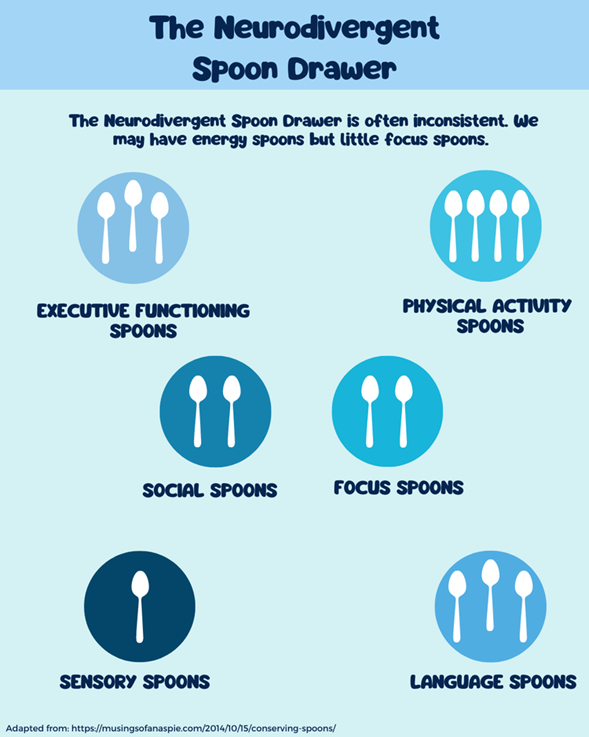
Through this, I’ve also learned that there are vast misconceptions regarding ADHD, ASD, or any other ‘invisible’ mental disability someone may have. For example, ADHD is often seen as quirky, or funny, or the “SQUIRREL!” disorder. What it does entail is not the lack of attention, but the lack of the ability to regulate attention. This makes it hard to focus in crowded environments, as you can’t focus on the person in front of you because you can’t help but tune in to everyone talking around you. This can cause sensory overload and exhaustion pretty easily—doubly so if you have multiple diagnoses. On top of this, as these folk are typically discriminated against, roughly half of your brain’s processing power is spent at all times trying to appear ‘normal’, or mask. This is also why I’d encourage people to seek help, in whatever form that comes; the proper support will help to mitigate your symptoms.
The biggest lesson I learned is that though it’s unlikely the majority of the time, employers do exist that recognize these problems, help to advocate for them, and work with their employees before giving up on them. eMoney’s the first employer—and more specifically home to the first manager I’ve had—where that’s happened for me. When I was having difficulties, rather than show me the door they worked to transfer me onto another team where my strengths were able to help me excel.
The points I’ve discussed above lead to the stigmas around mental health I’d like to see changed, and why I speak out when I’m able to now. The first is that these should not be easily written off/described disorders/disabilities; ADHD isn’t just the ‘Oh look, something shiny’ disorder, and ASD does not automatically make someone nonverbal or antisocial. Relatedly, just because someone had ADHD or is autistic does not mean they’re unable to function and thrive. After all, if you’ve met one autistic person, you’ve met one autistic person.


Thanks Tom for sharing. I really appreciate your openness and the knowledge you have spread in this article.
So glad you shared this. Thank you!
Thank you for reading! I hope it helps other folk be a bit more comfortable, and to not feel like they have to mask all day, every day.