
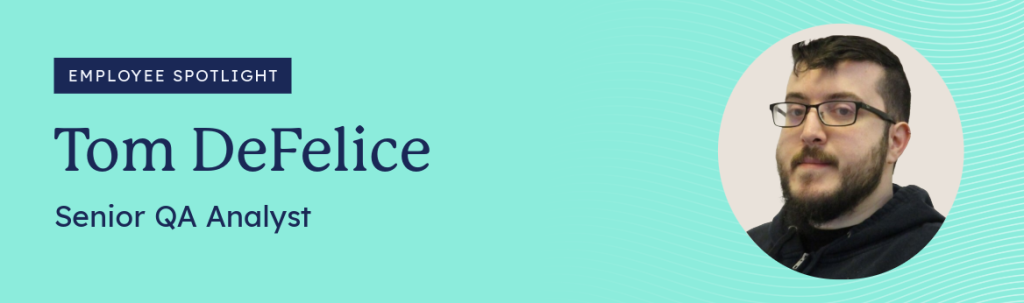
Tell us a little bit about yourself and your experience(s) being a part of the autistic community.
I’ve been with eMoney for almost 5 years, and I didn’t actually receive my diagnosis until about 3 years ago. Until then, I’d just been ‘that odd person that doesn’t handle social interaction well.’ Being diagnosed and being part of the community has allowed me to look back on my past through a new lens. A lot of it actually makes sense now, and I don’t focus on thinking there’s something wrong with me or that I’m somehow broken.
What challenges have you faced being autistic?
Most challenges have been what are viewed by most as social faux pas—maintaining eye contact is physically uncomfortable, having (especially unexpected) conversations with folks I’m not incredibly familiar with is difficult, and sudden (for lack of a better word at the moment) disasters sort of short-circuit me. It also causes issues with executive function (no doubt compounded by ADHD) which oftentimes prevents me from doing things I’d like to be doing—even things I enjoy. Imagine that you have to turn on a stove, but there are no knobs, dials, or buttons on the stove. You can tell someone to use the stove as much as you’d like, but there’s nothing there to interact with.
What makes you most proud of being autistic?
I would say that it allows me to become *incredibly* knowledgeable on topics that interest me, and I have a different way of thinking about a lot of things. For example, autistic folks usually have one (or more) special interests—these are *sort of* like hobbies? But more intense, if that makes sense—for me, those would be Final Fantasy XIV and the anime One Piece.
What are some common misconceptions about autism?
One big misconception is how autistic folks have been portrayed in the media. Three examples are Dustin Hoffman in Rainman, Andrew Miller (Kazan) in Cube, and Sean Penn in I Am Sam. While these have the problem of casting neurotypical folks in the role of autistic folks, Kazan winds up being the hero of Cube, and I Am Sam shows that even a person with traits leaning towards disability can hold down a steady job and life, if with some assistance.
The traits most people have come to associate with autism are the meltdowns—which *do* happen, but can be different for each person, and in most cases occur when the person’s put in a not-great/unhappy situation. I shutdown rather than meltdown, and I can’t actually speak without forcing myself too, which causes incredible stress/anxiety.
While there are folks whose autism is to the point of disability, a lot of us just excel/falter in different areas. The Autism Spectrum is typically viewed as linear with progression from ‘not autistic’ to ‘very autistic’, when it’s more like a multi-point circle graph—whereas one person might have difficulties with sensory input, perception, and motor skills but excel in language, another could excel in perception and executive function, but not be great at communicating. A quick Google of “autism spectrum circle” should bring up examples of what I mean.
A good saying is ”If you’ve met one autistic person, you’ve met one autistic person.”
Why is Autism Acceptance Month important to you?
It’s important because it brings to light a neurological condition that’s been viewed as this awful, pitiable thing for so long, when you could speak with/see an autistic person every day and not know. Notable autistic celebrities have helped with this cause, a few being Dan Akroyd, Anthony Hopkins, Jerry Seinfeld, and Wentworth Miller. Important to note for Autism Acceptance Month is that, while the puzzle piece has typically been used by organizations such as Autism Speaks, it’s viewed as mildly (if not outright) offensive, because the autistic community doesn’t want to be seen as a puzzle to figure out. Changing the month from ‘Awareness’ to ‘Acceptance’ has also been huge, because it’s not something to be cured or something that’s on the rise either—it’s just being recognized more often as people/doctors learn more.
What does diversity, equality and inclusion mean to you?
It means supporting the voices of folks in marginalized groups, be they people of color, disabled folks, or otherwise. It means not viewing any of these things as detriments to the person and instead seeing what strengths they can provide.
In your opinion, how does eMoney support an inclusive work environment?
Speaking for autism specifically–while eMoney is the first position I’ve held where my diagnosis was known, they’ve definitely been the most accommodating/inclusive. For one, though the Work From Home situation was brought on mainly by the pandemic, it’s been a huge boon—rather than having to be in an office with environmental sensory input (fluorescent lights are awful and having a ping pong table frequently audible just outside the door was maddening!), I/other folks can be in an environment where we’re comfortable. It’s made things immeasurably better. My manager has also been incredible in finding a group that worked for me (and where I excel.) Also, while blurring the line between ‘typical’ working hours and at home life is typically viewed as a failure of work-life balance, it allows me to be productive at the times of day when I’m most able to be—as long as I don’t miss deadlines of any sort!
What resources are available to learn more about autism? Can you share a list of reputable organizations?
Sure can! While this post itself is from 2019, the information is still valuable. Tt also explains why larger ‘charities’ such as Autism Speaks and the Autism Society, at best, aren’t great and, at worst, are harmful. Though it sounds flippant, looking at the neurodiversity community on social media (Instagram, TikTok, Facebook) is also helpful—anything that gives you insight from real autistic people!


As a fellow #actuallyautistic person, I just want to say that I love love loved reading this and can relate to so much of what you said! Thanks so much for sharing your story!
Thanks for sharing your insights and experiences, Tom! Your spotlight is incredibly impactful to me…I know we’re not very close, but learning from folks who “I know” has been the most meaningful and impactful way I’ve been able to learn and grow as a person. Thank you. Same goes for all you other associates who’ve agreed to put some extra time in and drop knowledge for the rest of us through these spotlights!
Thanks for sharing your story, Tom. I know this information will help a lot of people. So glad you are on our QA team!